

Having arrived almost ten years ago on the jaw-dropping shores of the Island of Hvar off the Dalmatian coast of Croatia, I knew instantly there must be a huge history and culture within the local communities when it comes to their food, wine and their love thereof in relationship to their rich heritage.
Previously having lived on the Mediterranean shores of Valencia, Spain I knew Croatia would have to prove its gastronomy to me at a high level.
Having always been a keen foodie and the willingness to taste all that is put in front of me, and then try to reproduce this in my kitchen, or Konoba as it’s called locally, I quickly became attached to the hip of Biserka my wonderful mother-in-law who quickly became my foodie inspiration.
‘Moj Micky’ as she would say with her infectious smile, I am now going to show you how to keep everyone happy. Biserka was born in Zastražišće a peaceful and nature-rich subsistence farming village on the Island of Hvar. Observing her at every moment and the passion and joy she showed when she was preparing different recipes using all local and sustainable produce sparked a flame within me to delve deep into this love for food and the ever-present social aspect. Never a dull moment (glass of wine in hand or rather a bottle) and cooking various dishes of Hvar Island.
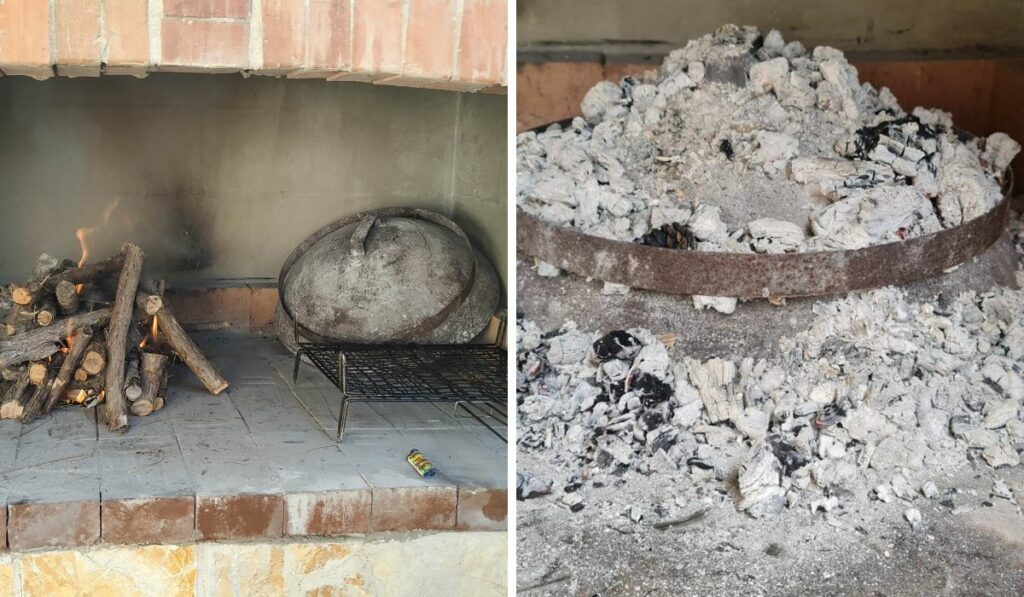
What I was quickly excited about was the interesting metal bell-like object that was hanging up next to the grill area. I had mastered the art of cooking a Paella in Spain and had then had the locals very impressed by my great enthusiasm to produce a mouthwatering meal equal to them.
Don’t have any testimonies but you can go on my word, and it was not just the wine speaking. Croatians like the Spanish I found are quite critical of the meal in front of them. All the better to keep you one step ahead and on your toes.
I had to dive in headfirst and give this wonderful dish a go…
So let me tell you a bit about the pre-prep and where our ingredients come from. What we will be doing on the day, preparing our ingredients and getting ready to share the ambiance of sitting with friends and family as they arrive in bits and drabs running up to lunchtime.
The PRESSURE is on.
Bearing in mind the whole process takes at least 3 to 4 hours this gives us a lot of time to catch up with all the news while tucking into some snacks beforehand.
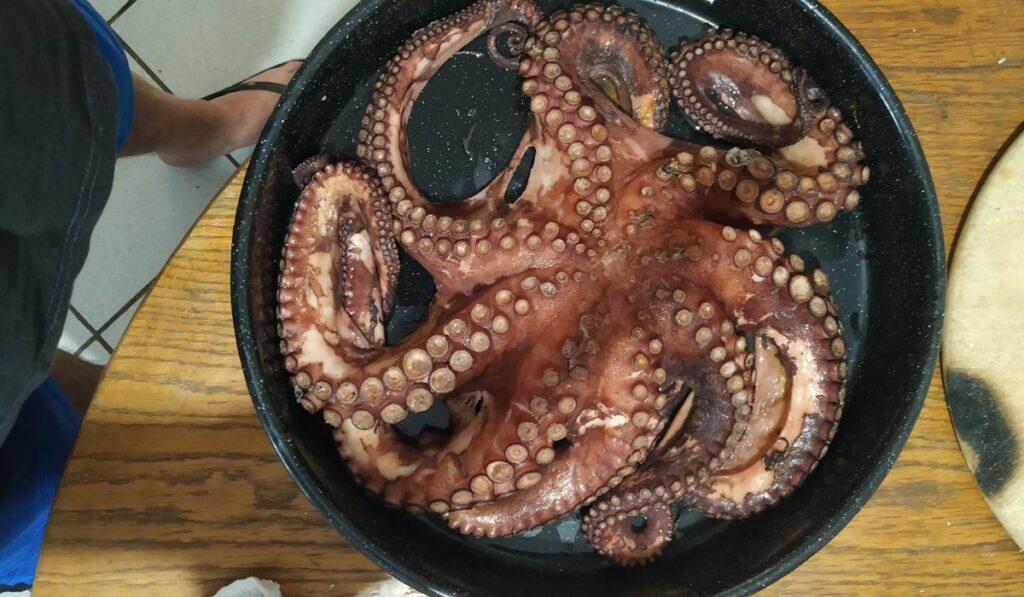
The Octopus is sustainably caught by either diving for them or off a small wooden fishing boat. Fresh from the clear blue Adriatic waters keeping in mind taking only what we need to feed ourselves for this occasion. This day was my partner’s birthday celebrated with all the family.
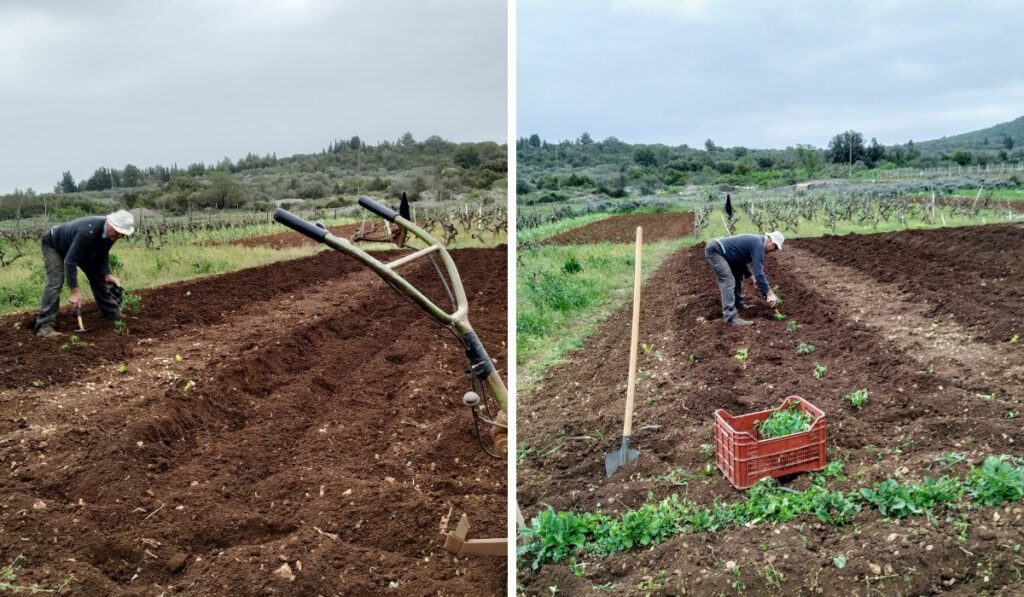
The fresh tomatoes, earthy potatoes, red peppers, oregano, and rosemary all come from our land and are certified pesticide-free by the authorities that check this for us alongside our orchards of olive trees and lavender.
Thinking of Sofia’s future and that of her heritage is something we treasure and to see her running around the fields and orchards with pure joy is irreplaceable.
Teaching her the WISE way and encouraging her to take in all the natural beauty that has come into her short 4 years of life gives us great happiness as well as her savoring all the flavours of the foods cooked. Especially the sweet ones 🙂
So, let’s get to the ‘nitty gritty’ as we say, and make this wonderful dish that brings us all together.
How do we go about pleasing everyone’s taste buds?
Follow my simple recipe and instructions step by step including the wood-burning process.
‘Where does it start’
- First and foremost, we need to make sure we have sourced our Octopus sustainably a few days before we cook.
- NB! Be sure to freeze it straight away to keep that salty freshness intact.
- Vegetables need to be fresh so preferably harvested from the fields the evening before.
- This is a great feeling as you know that tomorrow those flavours will be rich in taste.
- Herbs should be picked at the same time, with wonderful oregano and rosemary filling your nose with exquisite aromas.
- Prep will happen early morning, so be prepared to get a good night’s sleep and to get up early with the morning sun rising over the tranquil blue waters.
Ingredients (6-8 people)
- One large fresh frozen Octopus +- 2.5kg (whole not cut into pieces)
- Potatoes +- 6 large
- 2 whole large tomatoes
- 2 medium onions
- 1 large sweet red pepper
- Herbs (Oregano, Rosemary, Bay leaf)
- 1 teaspoon Salt and pepper
- Olive oil – Organic ½ cup
Instructions – Part 1:
The Fire
Build the wood pile for burning your wood. This is the fun part.
We use a blend of Olive and Vinewood from the orchards. It gives us amazing coals and burns slowly and the flavours it adds from the smoke are amazing.
Don’t be shy about the amount of wood as you never have too much, especially if you want to toast some old bread after or just keep the ambiance going.
Leave the fire to burn, adding wood as needed.
Part 2
Take out the Octopus (Hobotnica) from deep freeze (do not thaw)
Bring to a boil a large pot of water (no salt added).
Myth or not we add a wine cork to the water as Mumski as we affectionately called Biserka says it softens the Octopus even more. So, we will follow her wisdom or perhaps it was an excuse to open the wine early 🙂
Once boiling add the whole Octopus and boil for 30 – 40min.
Part 3
Prepare all vegetables
Wash, cut, and peel potatoes into quarters.
Wash and cut the wonderful ruby red tomatoes into quarters, skin on.
Slice into long thin pieces the red pepper.
Prepare herbs, I always go with a gut feeling, but use 4 sprigs of fresh rosemary and at least 1 tablespoon of crushed oregano, 2 –3 bay leaves dried (can use fresh if available) We are fortunate to have our own bay leaf tree.
1 teaspoon of salt and pepper (I use coarse sea salt in a grinder). Our sea salt is obtained sustainably from the Island of Pag, Dalmatia. Salt can always be adjusted at a later stage if necessary.
Part 4
Remove the Octopus from the boiling water and allow it to cool slightly. Then cut up the tentacles keeping their length from the head. Do not discard the head as this is used as well. Clean the head part and cut it up into pieces but do not rinse any part under water. We want to keep those flavours.
Put together all the ingredients into the pan (Our pan for this is approximately 45 cm (about 1.48 ft) in diameter and 10cm (about 3.94 in) deep. Needs to fit under a standard bell.
Sprinkle the olive oil over all the ingredients and mix well using your hands to really spread all the herbs and ingredients together.
Add ½ cup water as the moisture and water release will come from the Octopus and the tomatoes when cooking.
NB. We do not want to end up with huge amounts of liquid at the end.
Part 5
So, we are ready for the final stage.
Once our coals are nicely burnt down and we have a small fire going in the corner for reserves, we let the bell warm over them for 5 minutes. Always better to have a warm bell put over the dish.
Lift the bell and put it to one side once it is nicely warmed. Scrape away the coals creating a round space to put the dish on.
I normally put some Aluminum foil over the dish for the first part of cooking. For me, it slows the immediate cooking down. We don’t want to rush this as it needs to cook slowly for over 2 hours.
Cooking this way is kind of blind as once the bell is placed on top of the pan there is no opening again until halfway through the process and you cannot visually see the inside as normal oven cooking allows.
So, place the bell on top of the pan and scoop coals around the entire pan to just below the rim.
Then add coal onto the top of the bell which has a special ridge around it to stop coals from falling off.
To finish…
Now patience and nerves come into play.
This is not conventional cooking so there is no way to tell the inside temp and what is happening inside.
The thought of burning this dish arises from time to time and panic can set in so don’t rush it. Keep a steady heat around it and on top you can gauge with your hand how hot it is.

Time to open the chilled bottle of Zlatan Otok white wine from the slopes of the South side of Hvar.
Pull back a chair and watch with glee as this all comes together.
- After one hour of cooking carefully scrape off the coals from the top of the bell and its side.
- Lift bell with a metal pole as shown in the photo.
- Remove the foil slowly as it’s very hot and bound to release steam.
- Do not stir the ingredients, leave them exactly as is. If there is too much excess fluid remove it from the pan.
- Proceed to cover again except with no foil this time and cover like before with coals.
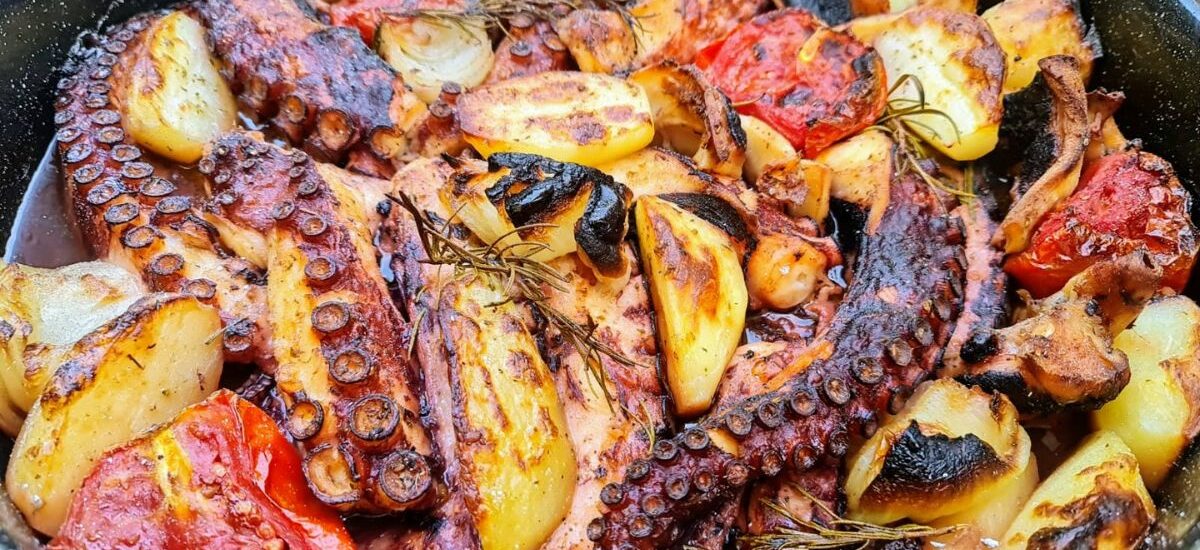
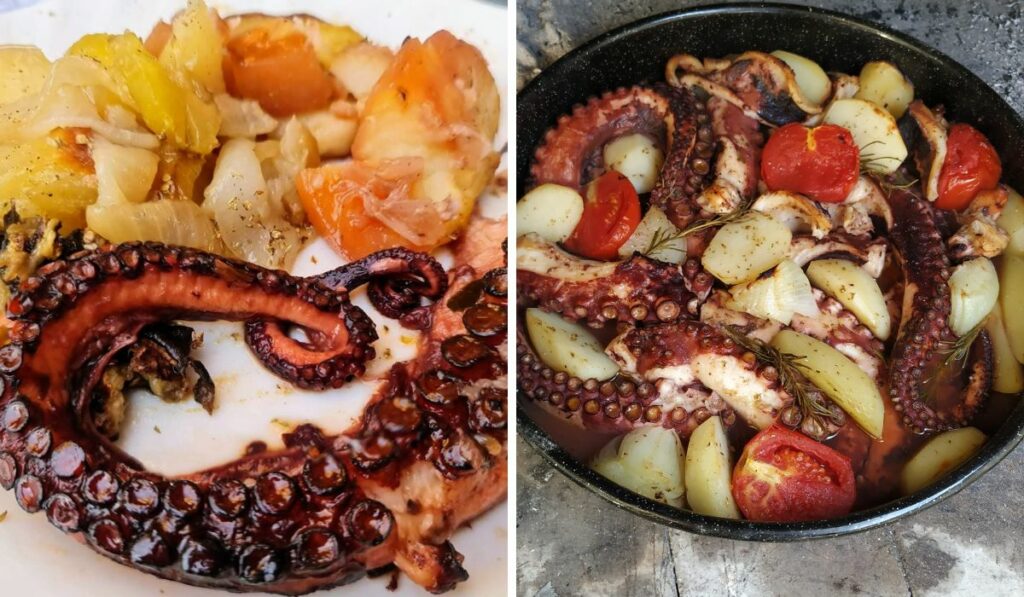
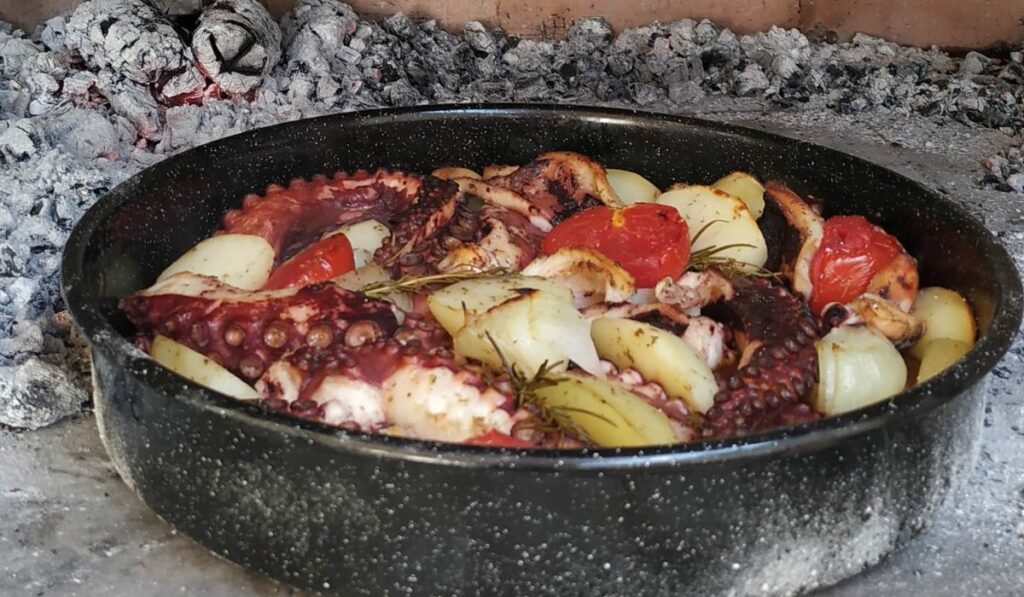
Now leave it to cook for at least another hour. You would have gauged from seeing it how well it was cooking, bearing in mind the aim is to get it to have a slightly natural stickiness and crisp outside once finished. The result should look like the first photo.
After an additional hour, I am sure it’s ready to be delivered to the table with a huge grin on your face to an eagerly awaiting bunch to satisfy the mouthwatering taste buds.
By now the voices have become loud and everyone is getting into the social side of the day. What more could you ask for? Good food, Beautiful Island weather, and a bunch of happy people
Enjoy and Dobar tek!
This feature is in the loving memory of our dear Biserka, Mom, Mumski, and Nona (grandma) who now watches us with a Beedy eye from the heavens that we are doing things just how she taught us.
Notes:
This dish has lamb and veal variations following the same recipe.
Recommended – extra potatoes can be prepared in a conventional oven while the bell is cooking.
An oven variation can be made if you do not have an outside grill area.
Please note only use enough for what you need on the day. Keep it sustainable.
